
Daily Dose of Awesomeness
Do You Need ICF Certification to Be a Spiritual Life Coach?
The Truth About ICF Certification for Spiritual Coaches (And What Actually Matters)
If you’re researching spiritual life coach certification and wondering whether you need an ICF-accredited program, this page will give you the facts.
We’re not here to attack ICF. We’re here to help you make a clear, informed decision about what’s actually right for your path as a spiritual coach.
What follows is the truth — all of it verifiable, none of it opinion disguised as fact.
What Is ICF Certification? (What Most People Don’t Realize)
The International Coaching Federation (ICF) is a credentialing organization. This is stated on their own website.
ICF does not train coaches. It does not teach coaching, spirituality, transformation, or any methodology. ICF reviews training programs created by others and — if those programs meet ICF’s criteria — accredits them.
When you enroll in an “ICF-accredited program,” you are learning from that program’s curriculum — not from ICF. ICF’s role is administrative: reviewing paperwork, issuing credentials (ACC, PCC, MCC), and collecting fees.
This is not a criticism. It’s simply what ICF is.
Many people assume “ICF-certified” means the program has been evaluated for depth or quality. That’s not accurate. ICF evaluates compliance with its competency model — not the depth, wisdom, or transformational power of any training.
Do You Need ICF Certification to Be a Life Coach?
Legally: No. Coaching is an unregulated profession worldwide. No license is required to practice coaching. You do not need ICF credentials — or any credentials — to legally work as a coach and serve clients.
For private clients: Rarely. Most private coaching clients choose coaches based on trust, resonance, and results — not credentials. ICF’s own research shows the majority of coaches get clients through referrals and relationships. Credentials rarely drive client decisions in private practice.
For corporate coaching: Sometimes. Some corporate HR departments prefer or require ICF credentials when hiring external coaches. If your goal is corporate coaching contracts, ICF credentials may be relevant to that specific market.
Bottom line: ICF certification is not required to be a life coach. It’s relevant primarily for corporate environments. For most private practice coaches — especially spiritual life coaches — it’s unnecessary.
Is ICF Certification Worth It for Spiritual Coaches?
This is not about ICF being “bad.” It’s about fit. ICF was designed for a specific context — and that context is not spiritual life coaching.
Here’s why ICF certification can actually be a problem if you’re called to spiritual coaching work:
The ICF Coaching Model Conflicts with Spiritual Coaching
ICF’s core competencies explicitly emphasize non-directive coaching. Coaches are trained to ask questions and reflect — not to advise, teach, guide, or share wisdom.
This works well in corporate settings where the goal is helping employees find solutions within existing structures.
Spiritual life coaching is fundamentally different. It often involves transmission, direct guidance, sharing wisdom from lived experience, working with consciousness and energy, and helping clients navigate territory you’ve walked yourself.
Training in the ICF model can condition you away from the very things that make spiritual coaching powerful.
ICF Credentials Don’t Measure What Makes a Good Spiritual Coach
ICF credentials are based on logged coaching hours, paperwork compliance, and assessments of adherence to their competency model.
They do not measure:
— Your depth of presence
— Your capacity to hold transformational space
— Your spiritual maturity and inner work
— Your own transformation and awakening
— The actual results your clients achieve
— The quality or depth of your methodology
The things that actually make a spiritual life coach effective are invisible to the ICF credentialing process.
ICF Certification Cost: Time and Money Without Depth
ICF credentials require renewal every three years. This includes Continuing Coach Education (CCE) credits, mentor coaching hours, and fees.
None of these requirements deepen your spiritual practice, expand your consciousness, or improve your ability to facilitate transformation. They exist to maintain compliance with ICF’s administrative system.
Time spent on credential maintenance is time not spent on actual growth, practice, or serving clients.
ICF Can Reinforce the Need for External Validation
Many spiritually called people already struggle with self-doubt and seeking external permission before trusting their own gifts.
The ICF credentialing path can reinforce this pattern: “I am legitimate because a credentialing body says so” rather than “I am ready because I’ve done the work and have something real to offer.”
For people prone to over-credentialing and permission-seeking, ICF can delay the step into authentic authority.
ICF Credentials Can Repel Spiritual Coaching Clients
Many spiritually-oriented clients are specifically seeking coaches outside the corporate paradigm. They want depth, authenticity, and wisdom — not bureaucratic credentials.
For some potential clients, “ICF Certified” signals exactly what they’re trying to avoid: generic, corporate, surface-level coaching.
For spiritually-oriented private clients, ICF credentials are often neutral at best — and a deterrent at worst.
What Actually Makes a Great Spiritual Life Coach
If ICF certification doesn’t determine your readiness or effectiveness as a spiritual coach, what does?
Depth of Your Own Inner Work
Clients transform in your presence to the degree that you’ve transformed yourself. Your spiritual practice, emotional maturity, and lived experience of awakening create the container for others’ growth.
Embodied Presence
The ability to be fully present, grounded, and attuned. To create safety not through technique, but through being. This is developed through years of practice — not credential programs.
A Real Transformational Methodology
Not just asking questions — but having clear pathways for helping people move through stuck places, access deeper truth, and create lasting change.
Results with Real Clients
What happens for people who work with you? How do their lives change? This is the only real measure of effectiveness — and no credential tracks it.
Lineage and Integrity
Learning from teachers who have walked the path, who carry genuine wisdom, who developed their work through real practice — not committees.
How to Choose the Best Spiritual Life Coach Training
When evaluating spiritual life coach certification programs — ICF-accredited or not — ask:
— Who created this training? What is their background and lineage?
— Does this program develop my depth, or just teach techniques?
— Will I learn a real methodology for transformation?
— What results do graduates create with their clients?
— Is this training aligned with how I actually want to serve?
ICF accreditation tells you a program meets ICF’s administrative criteria. It tells you nothing about depth, wisdom, spiritual alignment, or real-world results.
ICF Accredited vs Non-Accredited Programs: Which Is Right for You?
Choose an ICF-accredited program if:
— You want to work in corporate coaching or HR environments
— Your target market specifically requires ICF credentials
— You prefer a non-directive, question-based coaching style
Choose a non-ICF spiritual coaching program if:
— You feel called to spiritual transformation work
— You want to serve private clients seeking depth and awakening
— You value lineage, transmission, and wisdom over credentials
— You want training that develops your being, not just your technique
— You want to guide and teach, not just ask questions
The Truth About Becoming a Spiritual Life Coach
If you’ve read this far, you’re someone who cares about doing this right.
Here’s what we want you to know: You don’t need anyone’s permission to answer your calling. You don’t need a bureaucracy to validate your gifts. What you need is real training, real depth, and real support to step into the work you’re here to do.
ICF cannot give you that. It was never designed to.
Spiritual Life Coach Certification at Awakened Academy
Awakened Academy was founded in 2004 — before “spiritual life coaching” was a recognized category. We pioneered this field.
Our Spiritual Life Coach Certification trains real coaches who transform lives through depth, presence, and genuine mastery — not credential compliance.
Our training includes:
— 20+ years of proven methodology
— Spiritual practice and transmission at the core
— Real transformational tools that create results
— Direct mentorship from teachers who live this work
We don’t certify paperwork. We develop spiritual life coaches.
Ready to train for depth — not compliance? Learn more about our Spiritual Life Coach Certification.
Disclaimer: Awakened Academy is an independent spiritual life coach training organization. We are not affiliated with, accredited by, or endorsed by the International Coaching Federation (ICF). This information is provided to help prospective coaches make informed decisions about their training path.
The Truth About ICF Certification
What Spiritually Called Coaches Deserve to Know
If you’re exploring coach training and wondering whether you need an ICF-certified program, this page is for you.
We’re not here to attack ICF. We’re here to give you the facts — so you can make a clear, informed decision about what’s actually right for your path.
What follows is the truth. All of it is verifiable. None of it is opinion disguised as fact.
What ICF Actually Is
The International Coaching Federation (ICF) is a credentialing organization. This is stated clearly on their own website.
ICF does not train coaches. It does not teach coaching, spirituality, transformation, or any methodology. It reviews training programs created by others, and — if those programs meet ICF’s criteria — it accredits them.
When you enroll in an “ICF-accredited program,” you are learning from that program’s curriculum, not from ICF. ICF’s role is administrative: reviewing paperwork, issuing credentials, and collecting fees.
This is not a criticism. It’s simply what ICF is.
Understanding this distinction matters, because many people assume “ICF-certified” means they’re learning from ICF or that ICF has evaluated the depth or quality of the training. Neither is true. ICF evaluates compliance with its competency model — not the depth, wisdom, or transformational power of any program.
ICF Certification Is Not Required
Legally: Coaching is an unregulated profession. There is no license required to practice coaching anywhere in the world. You do not need ICF credentials — or any credentials — to legally call yourself a coach and serve clients.
For private clients: Most private coaching clients choose coaches based on trust, resonance, and results — not credentials. ICF’s own research shows that the majority of coaches get clients through referrals and relationships. Credentials rarely drive client decisions in private practice.
For corporate roles: Some corporate HR departments prefer or require ICF credentials when hiring external coaches. If your goal is corporate coaching contracts, ICF credentials may be relevant to that specific market.
The honest summary: ICF credentials are not required for coaching. They are relevant primarily for corporate environments. For most private practice coaches — especially those serving spiritually-oriented clients — they are unnecessary.
Why ICF Can Be a Problem for Spiritual Coaches
This section is not about ICF being “bad.” It’s about fit. ICF was designed for a specific context, and that context is not spiritual coaching.
1. The ICF model discourages what spiritual coaching requires
ICF’s core competencies explicitly emphasize non-directive coaching. The coach is trained to ask questions and reflect — not to advise, teach, guide, or share wisdom.
This approach works well in corporate settings where the goal is to help employees find their own solutions within existing structures.
Spiritual coaching is fundamentally different. It often involves transmission, direct guidance, sharing wisdom from experience, working with consciousness and energy, and helping clients navigate territory you’ve walked yourself. These are not “non-directive” activities.
Training in the ICF model can actually condition you away from the very things that make spiritual coaching powerful.
2. ICF credentials don’t measure what matters
ICF credentials are based on logged hours, paperwork compliance, and assessments of adherence to their competency model.
They do not measure:
— Your depth of presence
— Your capacity to hold space
— Your spiritual maturity
— Your own transformation
— The results your clients achieve
— The quality of your methodology
The things that actually make a spiritual coach effective are invisible to the ICF credentialing process.
3. The ongoing requirements drain time and money without building depth
ICF credentials require renewal every three years. This includes continuing education credits, mentor coaching hours, and fees.
None of these requirements are designed to deepen your spiritual practice, expand your consciousness, or improve your ability to facilitate transformation. They exist to maintain compliance with ICF’s administrative system.
Time spent on credential maintenance is time not spent on actual growth, practice, or serving clients.
4. For some, it reinforces the habit of seeking external permission
Many spiritually called people already struggle with self-doubt and the tendency to seek external validation before trusting their own gifts.
The ICF credentialing path can reinforce this pattern: the message becomes “I am legitimate because a credentialing body says so” rather than “I am ready because I’ve done the work, walked the path, and have something real to offer.”
For people prone to over-credentialing and permission-seeking, ICF can delay — rather than support — the step into authentic authority.
5. ICF credentials can actually repel the clients you’re meant to serve
Many spiritually-oriented clients are specifically looking for coaches who are outside the corporate paradigm. They want depth, authenticity, and wisdom — not bureaucratic credentials.
For some potential clients, seeing “ICF Certified” signals exactly what they’re trying to avoid: generic, corporate, surface-level coaching.
This isn’t true for everyone. But for spiritually-oriented private clients, ICF credentials are often neutral at best — and a deterrent at worst.
What Actually Matters for Spiritual Coaching
If ICF credentials don’t determine your readiness or effectiveness, what does?
Your own inner work
Clients transform in your presence to the degree that you’ve transformed yourself. Your depth of practice, your emotional maturity, your lived experience of awakening — these create the container for others’ growth.
Embodied presence
The ability to be fully present, grounded, and attuned. To create safety not through technique, but through being. This is developed through years of practice — not credential programs.
A real transformational method
Not just asking questions — but having clear pathways for helping people move through stuck places, access deeper truth, and create lasting change. Methodology matters.
Results with real people
What happens for people who work with you? How do their lives change? This is the only real measure of a coach’s effectiveness — and no credential tracks it.
Lineage and integrity
Learning from teachers who have walked the path, who carry genuine wisdom, who developed their work through real practice — not committees. Spiritual coaching has roots. Those roots matter.
How to Choose the Right Training
When evaluating any coach training program — ICF-accredited or not — ask:
— Who created this training? What is their background and lineage?
— Does this program develop my depth, or just teach techniques?
— Will I learn a real methodology for transformation?
— What results do graduates create with their clients?
— Is this training aligned with how I actually want to serve?
ICF accreditation tells you a program meets ICF’s administrative criteria. It tells you nothing about depth, wisdom, spiritual alignment, or real-world results.
The Invitation
If you’ve read this far, you’re someone who cares about doing this right.
Here’s what we want you to know: You don’t need anyone’s permission to answer your calling. You don’t need a bureaucracy to validate your gifts. What you need is real training, real depth, and real support to step into the work you’re here to do.
ICF cannot give you that. It was never designed to.
About Awakened Academy
Awakened Academy was founded in 2004 — before “spiritual life coaching” was a recognized category.
We exist to train real spiritual life coaches: people who transform lives through depth, presence, and genuine mastery — not credential compliance.
Our training is built on:
— 20+ years of refining what actually works
— Spiritual practice and transmission at the core
— Methodology that creates real transformation
— Direct mentorship from teachers who live this work
We don’t certify paperwork. We develop people.
If you’re ready to train for depth — not compliance — we’re here.
Note: Awakened Academy is an independent training organization. We are not affiliated with, accredited by, or endorsed by the International Coaching Federation. The information above is provided for educational purposes to help prospective coaches make informed decisions.
🌟 Is Spiritual Coaching a Legitimate Career? (2025 Guide)
Short Answer:
Yes — spiritual coaching is a legitimate, impactful, and financially sustainable career path. As more people seek purpose beyond traditional success, demand for heart-centered spiritual guidance continues to grow.
✅ Why Spiritual Coaching Is a Real Career
1. It Solves a Real Problem
Spiritual coaches support people who are:
-
Experiencing a spiritual awakening or life transition
-
Seeking purpose beyond material success
-
Looking for meaning, not just mindset fixes
They fill a vital gap between therapy and life coaching — guiding people through soul-level transformation.
2. It’s in High Demand
-
35% of Americans identify as “spiritual but not religious”
-
The global wellness industry is worth $4.4T — and growing
-
Spiritual keywords (like “chakra healing” or “inner purpose”) continue to trend on Google, TikTok & YouTube
People are paying for deeper support — and they’re seeking coaches, not gurus.
3. It Generates Real Income
Spiritual coaches earn through:
-
1:1 sessions ($75–$300/hr)
-
Group programs ($500–$3,000 per launch)
-
Online courses ($97–$2,000+)
-
Retreats or intensives ($2,000–$10,000 per attendee)
-
Memberships ($29–$197/month)
The most successful coaches build layered income streams and serve clients at different stages of their journey.
📘 Do You Need a Certification?
No legal license is required. However, training matters — especially to:
-
Learn ethical coaching skills
-
Understand trauma-awareness
-
Gain structure and spiritual tools
-
Build business confidence
🧭 Authenticity and lived experience often matter more than credentials. But a quality certification (like Awakened Academy’s) can accelerate your growth.
💡 Is It Ethical to Charge for Spiritual Services?
Yes — when done with integrity. You’re not charging for Spirit; you’re charging for:
-
Your time and presence
-
Your training and experience
-
The structure and safety you provide
Ethical spiritual coaches:
-
Avoid grandiose promises
-
Respect client autonomy
-
Refer out when needed
👣 Who Succeeds in This Field?
Successful spiritual coaches:
-
Have a deep spiritual practice
-
Speak clearly and compassionately
-
Set healthy professional boundaries
-
Invest in their business skills
-
Focus on real transformation, not trends
🌍 A Career That Combines Purpose + Prosperity
Spiritual coaching lets you:
-
Do meaningful, soul-aligned work
-
Serve people deeply
-
Earn income from your inner wisdom
-
Work online, from anywhere in the world
It’s not a quick-fix job — but if you’re called to help others awaken, it’s one of the most fulfilling careers available today.
🙋♀️ FAQs
❓ Is spiritual coaching a legit business?
Yes — coaches legally operate businesses around the world, offering spiritual support just like life coaches or therapists (within their scope).
❓ Can you actually make a living?
Absolutely. Many full-time coaches earn $3K–$15K+ monthly through services and digital products.
❓ What’s the difference between spiritual coaching and therapy?
Therapists focus on diagnosis and mental health. Spiritual coaches help clients align with purpose, navigate spiritual growth, and access inner wisdom.
❓ How do I get started?
Start with your own inner work, find a mentor or program, and begin building your practice — one aligned step at a time.
🚀 Ready to Turn Your Calling into a Career?
Explore the full step-by-step guide to building a thriving spiritual coaching business:
👉 How to Start a Spiritual Coaching Business
Learn how to package your wisdom, attract soul-aligned clients, and create a business that changes lives — including yours.
Explore Our Spiritual Coaching Services

Personal Growth Sessions
Our personal growth sessions are designed to help you unlock your full potential by aligning your spiritual and personal goals. Through guided meditation and personalized coaching, you’ll gain clarity and confidence.
Mindfulness and Meditation Workshops
Join our mindfulness and meditation workshops to cultivate a deeper sense of peace and presence. These sessions are perfect for reducing stress and enhancing your overall well-being.
Life Purpose Discovery
Discover your true life purpose with our specialized coaching. We guide you through self-exploration exercises and spiritual insights to help you find meaning and direction in your life.
Common Questions About Spiritual Coaching
Spiritual coaching is a growing field that combines traditional coaching techniques with spiritual practices to help individuals achieve personal and spiritual growth.
Is spiritual coaching a legitimate career?
Yes, spiritual coaching is a legitimate career. It involves helping clients achieve personal growth and spiritual enlightenment through various techniques and practices.
How effective is spiritual coaching?
Spiritual coaching can be highly effective for those seeking personal transformation and spiritual growth. It provides tools and guidance to help individuals overcome challenges and achieve their goals.
What qualifications do spiritual coaches have?
Spiritual coaches often have certifications in coaching or related fields, along with a deep understanding of spiritual practices and principles. Many also have personal experience in spiritual growth.
Can spiritual coaching help with stress management?
Yes, spiritual coaching can be a powerful tool for stress management. Techniques such as meditation, mindfulness, and spiritual guidance can help reduce stress and improve mental well-being.
What Does a Spiritual Coach Actually Do?
A spiritual coach is a guide who helps individuals connect with their inner selves, fostering personal growth and self-awareness. By focusing on spiritual well-being, they assist clients in overcoming obstacles, finding clarity, and achieving a balanced life. Through personalized sessions, spiritual coaches empower individuals to explore their beliefs, values, and purpose, ultimately leading to a more fulfilling and harmonious existence.
Short Answer:
A spiritual coach helps people connect with their inner wisdom, move beyond limiting beliefs, and live in alignment with their higher purpose. Unlike therapists or life coaches, spiritual coaches guide deep, soul-centered transformation.
🔍 What Is the Role of a Spiritual Coach?
A spiritual coach supports personal and spiritual growth by helping clients:
-
Navigate awakenings, transitions, or emotional blocks
-
Break free from patterns driven by fear, ego, or doubt
-
Reconnect with their intuition and life purpose
-
Explore mindfulness, energy work, and spiritual tools
-
Live more authentically in alignment with their soul
Coaching is delivered through 1:1 sessions, group work, courses, or immersive retreats.
🌱 Who Works with a Spiritual Coach?
Spiritual coaching is ideal for people who:
-
Feel unfulfilled despite success or external achievements
-
Are going through a spiritual awakening or shift
-
Crave deeper clarity, peace, or purpose
-
Seek support beyond traditional therapy or coaching
Most clients are already engaged in personal growth and want support that’s aligned with inner transformation.
🛠️ Common Tools Used by Spiritual Coaches
Each coach uses different tools based on their style and the client’s needs. Common methods include:
-
Guided meditation and breathwork
-
Journaling prompts for reflection and insight
-
Oracle or tarot cards (if aligned)
-
Intuitive guidance or channeled messages
-
Energy healing or chakra balancing
-
Shadow work, inner child dialogue, or soul inquiry
These practices help clients release emotional blocks and access their own wisdom.
⚖️ How Is Spiritual Coaching Different from Life Coaching or Therapy?
| Modality | Focus | Tools Used | Typical Outcome |
|---|---|---|---|
| Life Coach | Goals, performance, habits | Action plans, accountability | External success & productivity |
| Therapist | Mental health, trauma, diagnosis | Clinical tools, CBT, EMDR | Emotional healing & stability |
| Spiritual Coach | Soul growth, inner truth, alignment | Intuition, presence, energy work | Purpose, clarity, spiritual fulfillment |
Spiritual coaches are not therapists, but they complement other healing modalities by helping clients explore deeper meaning and higher awareness.
📘 Do You Need a Certification?
No certification is legally required to become a spiritual coach. However, formal training offers:
-
Structured coaching techniques
-
Guidance on ethics and client safety
-
Tools for spiritual and energetic work
-
Confidence in holding transformational space
Clients value authenticity, integrity, and personal experience even more than formal credentials.
🔎 How to Choose the Right Spiritual Coach
Look for a spiritual coach who:
✅ Aligns with your values and worldview
✅ Offers a discovery call or consultation
✅ Is transparent about their training and methods
✅ Encourages your growth — not dependency
🛑 Red flags include:
-
Promises of instant miracles
-
Pressure to buy expensive packages
-
Claims of being the only “true” way
The best spiritual coaches help you access your own guidance, not just follow theirs.
🌍 Why Spiritual Coaching Is Growing in Demand
As more people step away from rigid belief systems or purely goal-based living, spiritual coaching offers a powerful bridge:
🌿 Ancient wisdom + modern life tools
🧭 Personal growth + soul alignment
🧘 Non-dogmatic support for inner transformation
Spiritual coaches are helping people live more awake, connected, and meaningful lives — especially in times of rapid change or uncertainty.
🗣️ Voice Search Ready Answer:
“Hey Siri, what does a spiritual coach do?”
→ They help people live more aligned, soulful lives by guiding them through inner transformation and spiritual growth.
🙋♀️ Frequently Asked Questions About Spiritual Coaching
❓ What is spiritual coaching in simple terms?
Spiritual coaching helps people connect with their inner self, release limiting beliefs, and live with greater clarity and purpose.
❓ Do you need a certification to be a spiritual coach?
No. There are no legal requirements for certification. However, training programs can help you learn ethical practices, develop coaching skills, and build confidence.
❓ How is a spiritual coach different from a therapist?
Therapists focus on healing mental health issues and trauma. Spiritual coaches support soul growth, alignment, and inner purpose — often using intuition and energy-based tools.
❓ What happens in a typical spiritual coaching session?
You may experience guided meditation, journaling, intuitive insight, breathwork, or deep conversation. The session is tailored to your personal growth journey.
❓ Can spiritual coaching help with anxiety or emotional struggles?
Yes, but it’s not a replacement for therapy. It can support emotional wellness by helping you shift limiting beliefs and access deeper peace and meaning.
❓ How much do spiritual coaches charge?
Rates vary. Many charge between $50 and $150 per session. Some offer packages, sliding scale pricing, or group programs.
❓ Is spiritual coaching religious?
No. Most spiritual coaches work in an inclusive, non-religious way. They help clients explore personal spirituality — whatever that looks like for them.
🚀 Ready to Start Your Own Spiritual Coaching Business?
If you’re feeling called to share your gifts and guide others on their soul journey, don’t miss this step-by-step guide from Awakened Academy:
👉 How to Start a Spiritual Coaching Business
Learn how to turn your passion into a purpose-led business, attract aligned clients, and make a real impact — spiritually and financially.
Our Spiritual Coaching Services
One-on-One Coaching
Experience personalized guidance tailored to your unique spiritual journey, helping you overcome challenges and achieve personal growth.
Group Workshops
Join our interactive workshops to connect with like-minded individuals and explore various spiritual practices in a supportive environment.
Meditation Classes
Learn meditation techniques to enhance mindfulness, reduce stress, and cultivate inner peace.
Retreats
Participate in immersive retreats designed to deepen your spiritual practice and rejuvenate your mind, body, and soul.
Understanding the Process
1
Initial Consultation
Begin with a one-on-one session to discuss your goals and aspirations.
2
Personalized Plan
Receive a customized roadmap designed to guide your spiritual growth.
3
Ongoing Sessions
Engage in regular meetings to track progress and adjust strategies.
Discover Your Path to Inner Peace
Unlock your potential and find clarity with personalized spiritual coaching. Connect with us today to explore how we can guide you on your journey to self-discovery and fulfillment.

How to Create a Signature Spiritual Coaching Package That Sells (2026 Guide)
Transform your spiritual gifts into a thriving, purpose-driven business that serves your highest calling while creating lasting impact for your clients.

Spiritual Coaching Packages vs. Hourly Sessions
Many spiritual coaches begin their practice by charging an hourly rate. It feels safe, flexible, and low-pressure. But this model quietly works against you and your clients.
True spiritual transformation rarely happens in a single 60-minute session. It requires a journey — a sacred container of consistent support, integration, and energetic accountability. When you sell hours, you are selling time. When you sell a package, you are selling a result.
First, deeper client commitment. A client who invests $3,500 in a 12-week journey is energetically all-in. They show up differently, do the work, and get far better results than someone who books a one-off session.
Second, predictable, sustainable income. Packages allow you to plan your month, set boundaries around your energy, and build a business that doesn’t require you to constantly hustle for the next booking.
Third, holistic, high-value support. A package allows you to include between-session Voxer support, custom meditations, workbooks, and rituals — elements that are impossible to deliver in an hourly model and that justify premium pricing.
How to Choose Your Spiritual Coaching Niche First
Before you can create a package that sells, you must know exactly who you are creating it for. Your spiritual coaching niche is the intersection of your unique gifts and the specific transformation your ideal clients are seeking.
Are you an intuitive healer helping empathic women release ancestral trauma? Are you a mindset coach guiding spiritual entrepreneurs to manifest abundance in their businesses? The more specific your niche, the more powerfully your package will resonate — and the easier it becomes to price it at a premium.
When you try to speak to everyone, your message resonates with no one. By narrowing your focus, you become the clear, obvious choice for the people who need your specific medicine.
Why Your Signature Package Changes Everything
Most spiritual coaches start with scattered offerings — random sessions, unclear outcomes, inconsistent pricing. This approach leaves both coach and client feeling unfulfilled and uncertain about the journey ahead.
Step 1 — Define Your Unique Transformation
The foundation of any powerful coaching package is crystal-clear transformation. Your clients aren’t just buying sessions — they’re investing in becoming a new version of themselves.
• What specific pain point keeps your ideal clients awake at night?
• What would their life look like after working with you?
• What is the emotional, spiritual, or energetic shift you guide them through?
• What makes your approach different from other spiritual coaches?
• “From Spiritual Overwhelm to Confident Intuition” — For empaths who feel drained by others’ energy
• “Awakening Your Divine Feminine Power” — For women disconnected from their sacred creativity
• “Breaking Generational Patterns” — For those ready to heal ancestral trauma and step into their authentic power
• “From People-Pleaser to Purpose-Led” — For highly sensitive souls who’ve lost themselves in others’ expectations
Step 2 — Design Your Sacred Structure
Your package structure should honor both the spiritual journey and practical business needs. Consider your energy capacity, client commitment levels, and the depth of transformation you facilitate.
|
Package Type
|
Duration
|
Session Structure
|
Investment Range
|
Best For
|
|
Soul Spark Intensive
|
4–6 weeks
|
Weekly 75-min sessions
|
$800–$1,500
|
Quick breakthroughs, specific blocks
|
|
Transformation Journey
|
8–12 weeks
|
Bi-weekly 90-min sessions + support
|
$1,500–$3,500
|
Comprehensive life shifts
|
|
Sacred Year
|
6–12 months
|
Monthly intensives + ongoing support
|
$3,000–$8,000
|
Deep spiritual mentorship
|
Components of a Premium Spiritual Coaching Package
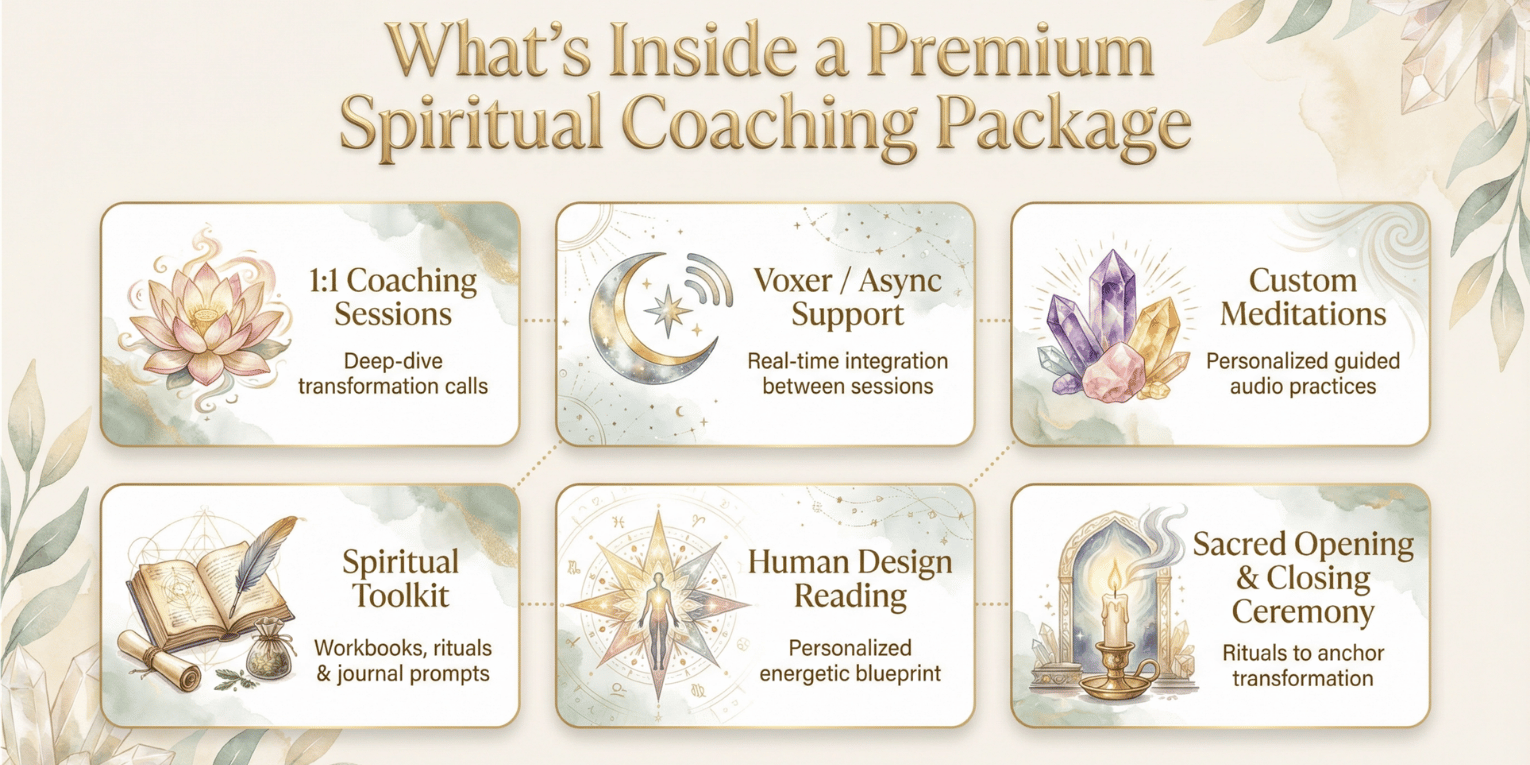
When designing a high-ticket spiritual coaching package, you are creating a sacred container for your client’s growth. A premium transformational package should include far more than just Zoom calls. The additional elements you provide are what justify your pricing and differentiate you from coaches charging hourly rates.
The core components of a premium package are:
1:1 Coaching Sessions form the heart of the work — deep-dive calls (typically 60–90 minutes, weekly or bi-weekly) where the real transformation happens. These are the non-negotiable foundation.
Asynchronous Support via Voxer, WhatsApp, or email allows clients to reach you between sessions for real-time integration, energetic check-ins, and accountability. This is often the element clients value most.
Custom Spiritual Practices — personalized guided meditations, breathwork sequences, or ritual guides tailored to the client’s specific blocks and breakthroughs — elevate your package from a coaching program to a sacred experience.
A Resource Library of workbooks, journal prompts, and recorded teachings supports the core curriculum and gives clients something to return to long after the program ends.
A Welcome and Offboarding Ceremony — a sacred opening ritual to set intentions at the start and a closing integration session to celebrate their growth — creates a sense of completion and transformation that clients remember and share.
Step 3 — Craft a Soul-Stirring Package Name
Your package name should immediately communicate both the transformation and the feeling clients will experience. It is the first energetic impression of your work.
Naming Formula: [Desired Feeling/State] + [Transformation Method] + [Time/Journey Element]
Inspired Examples:
“Radiant Boundaries: A 6-Week Energy Mastery Journey”
- “Sacred Rebellion: Break Free & Lead with Your Truth”
- “Intuitive Empress: Awakening Your Inner Knowing in 8 Weeks”
- “Soul Fire Revival: Reignite Your Purpose & Passion”
- “Divine Feminine Rising: From Depletion to Devotion”
Say your package name out loud. Does it make you feel excited and aligned? Does it capture the essence of the transformation you offer?
Map the Transformation Journey
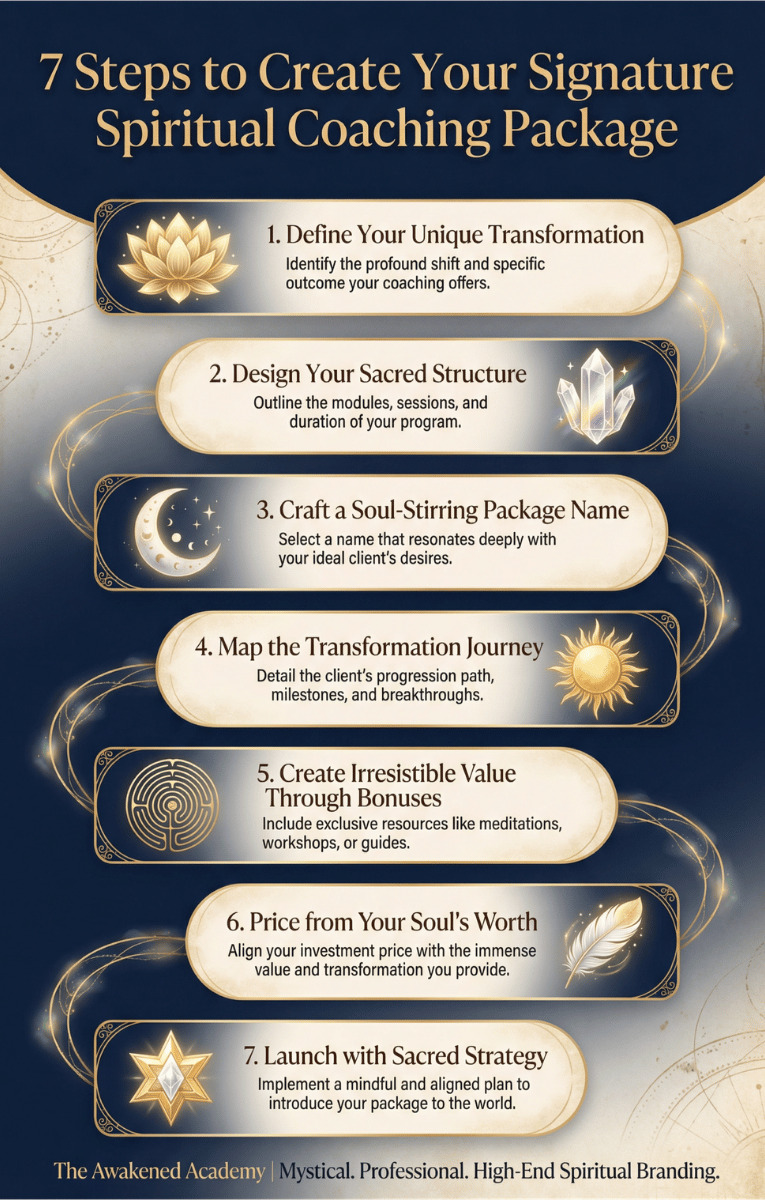
Even intuitive coaches need structure. Clients invest more confidently when they can visualize their journey. Create a session-by-session outline that feels both organized and fluid.
Sample 8-Week Journey: “Intuitive Empress Awakening”
Week 1: Sacred Foundation — Set intentions, create energetic boundaries, establish spiritual practices
Week 2: Clearing the Static — Release energetic blocks, heal past wounds that cloud intuition
Week 3: Opening the Channels — Activate psychic centers, strengthen connection to higher guidance
Week 4: Trusting the Whispers — Learn to distinguish intuition from fear, practice daily guidance
Week 5: Embodying Your Gifts — Integrate spiritual abilities into daily life and relationships
Week 6: Speaking Your Truth — Express intuitive insights with confidence and compassion
Week 7: Leading with Intuition — Apply spiritual guidance to major life decisions and goals
Week 8: The Empress Emerges — Integration, celebration, and creating your ongoing spiritual practice
While structure builds trust, leave room for spirit to guide each session. Your outline is a container, not a cage.
Step 5 — Create Irresistible Value Through Bonuses
Bonuses should enhance the transformation without overwhelming your client or depleting your energy. Think quality over quantity.
High-Value Bonus Ideas:
- Custom Guided Meditation recorded specifically for their journey
- Spiritual Toolkit PDF with daily practices, affirmations, and ritual guides
- Emergency Energy Clearing — quick techniques for challenging moments
- Goddess/God Archetype Reading — personalized spiritual guidance
- Private community access for ongoing connection
- Integration Ceremony — a closing ritual to anchor their transformation
Bonus Naming Magic: Instead of “PDF Workbook,” offer “Your Intuitive Empress Guidebook.” Instead of “Email Support,” create “Sacred Text Portal for Divine Downloads.” Instead of “Final Session,” design “Your Empress Coronation Ceremony.”
Step 6 — Price from Your Soul’s Worth
Spiritual coaches often struggle with pricing because we are taught to serve from sacrifice. But undercharging dishonors both your gifts and your clients’ transformation.
Pricing Psychology:
- What is the cost of not solving their problem? (Staying stuck, living unfulfilled, spiritual disconnection)
- What is the value of the transformation? (New career, healed relationships, spiritual confidence)
- What would they pay for this result elsewhere? (Therapy, retreats, courses combined)
Pricing Guidelines:
- 4–6 Week Intensive: $800–$2,000
- 8–12 Week Journey: $1,500–$4,000
- 3–6 Month Immersion: $3,000–$8,000+
Your pricing should feel slightly uncomfortable — that is growth. If it feels too easy, you are likely undercharging.
Real Spiritual Coaching Package Examples & Pricing

To help you visualize what this looks like in practice, here are three concrete examples of how you might structure and price your spiritual coaching packages.
Example 1: The “Intuitive Awakening” Starter Package
This is the ideal entry-level offer for coaches who are just beginning to build their client base. It delivers a focused, specific transformation in a short timeframe, making it easy for clients to say yes.
- Duration: 4 Weeks
- Target Audience: Beginners seeking clarity and connection to their intuition
- Includes: 4 x 60-minute sessions, email support (Mon–Fri), and a custom daily grounding meditation
- Pricing: $1,200–$1,500
Example 2: The “Deep Healing” Transformational Journey
This is the signature offer that most spiritual coaches build their business around. It provides enough time for genuine, lasting transformation and enough depth to justify a premium investment.
-
Duration: 12 Weeks (3 Months)
- Target Audience: Clients ready to clear deep energetic blocks and step into their power
- Includes: 6 x 90-minute bi-weekly sessions, unlimited Voxer support (Mon–Fri), a personalized spiritual toolkit, and an astrology or human design reading
- Pricing: $3,500–$5,000
Example 3: The “Sacred CEO” High-Ticket Immersion
This is the premium, high-ticket offer for experienced coaches working with spiritual entrepreneurs or clients navigating major life transitions.
Duration: 6 Months
- Target Audience: Spiritual entrepreneurs scaling their soul-led businesses
- Includes: 12 x 60-minute sessions, priority Voxer access, monthly energetic clearings, and a half-day VIP virtual intensive
- Pricing: $8,000–$12,000+
Step 7 — Launch with Sacred Strategy
Pre-Launch Preparation:
Test Your Offer — Work with 1–2 beta clients to refine the process
- Gather Testimonials — Document transformation stories and client feedback
- Create Your Sales Page — Focus on transformation, not just features
- Plan Your Launch — Soft launch to your list, then broader marketing
Launch Day Ritual:
Ground Yourself — Meditate, sage your space, set intentions
- Call in Your Tribe — Energetically invite your ideal clients
- Share from Your Heart — Post authentically about why this work matters
- Trust Divine Timing — Release attachment to immediate results
Integration — Your Package as Sacred Service
Remember, your signature coaching package isn’t just a business offering — it is a sacred service that helps souls remember who they truly are. When you approach package creation from this perspective, everything shifts.
Your package becomes a spiritual invitation for those ready to transform, an energetic container that holds space for miracles, a sacred exchange of energy, wisdom, and transformation, and a legacy of healing that ripples through generations.
Final Reflection Questions:
Does this package excite and slightly scare you? (Good — that means it is aligned with your growth edge.)
- Can you clearly articulate the transformation in one sentence?
- Does the pricing honor both your worth and your clients’ investment?
- Are you ready to hold space for this level of transformation?
Your Next Sacred Steps
- Complete the transformation clarity exercise — write your one-sentence transformation statement
- Choose your package structure — select duration and session frequency that feels sustainable
- Craft your package name — something that makes your soul sing when you say it
- Outline your journey — create your week-by-week transformation map
- Set your investment — price from worth, not fear
- Find your first client — share your vision and invite someone to journey with you
The world needs your unique gifts. Your package isn’t just about building a business — it’s about answering your soul’s calling to serve, heal, and transform lives. Trust the process, honor your gifts, and know that your ideal clients are already seeking exactly what you offer.
Your signature package is ready to be born. Will you trust yourself enough to let it emerge?
Frequently Asked Questions About Spiritual Coaching Packages
How much should I charge for a spiritual coaching package?
Pricing should reflect the value of the transformation you deliver, not just the time you spend. For a new spiritual coach, a 4-week package typically ranges from $800 to $1,500. A comprehensive 12-week transformational package usually ranges from $3,000 to $5,000+. As your experience, reputation, and demand grow, your prices should increase accordingly. The key is to price from your worth, not from fear.
What should be included in a 12-week spiritual coaching program?
A 12-week spiritual coaching program should include regular 1:1 sessions (weekly or bi-weekly), between-session support such as Voxer or email access, custom spiritual practices like personalized meditations or rituals, and a clear curriculum or roadmap that guides the client from their current state to their desired transformation. Many coaches also include a human design or astrology reading as a premium bonus.
How do I transition from hourly sessions to high-ticket packages?
Start by identifying the most common transformation your current hourly clients achieve. Package that journey into a 3-month container with a clear outcome, defined sessions, and between-session support. Notify your existing clients that you are transitioning to a package model to better serve them, and offer them a special founding client rate. Then update your website, social media, and discovery call process to reflect your new offer.
What is the difference between a spiritual coaching package and a regular life coaching package?
A spiritual coaching package incorporates spiritual modalities — such as energy work, intuitive guidance, meditation, ritual, and soul-level exploration — alongside traditional coaching frameworks. While a life coaching package focuses primarily on goals, mindset, and action steps, a spiritual coaching package addresses the energetic and soul-level roots of a client’s challenges, creating deeper and more lasting transformation.
How many clients can I work with in a spiritual coaching package model?
Most spiritual coaches work with between 5 and 15 clients at a time in a package model, depending on the depth of support included. A high-touch, high-ticket package with daily Voxer access may limit you to 5–8 clients, while a bi-weekly session model with limited between-session support could accommodate 12–15. Always design your capacity around your energy, not just your income goals.
25 Profitable Spiritual Coaching Niche Ideas for 2026
Choosing your spiritual coaching niche is the portal to deeper transformation, consistent clients, and a business that feels sacred.

Choosing your spiritual coaching niche is one of the most important decisions you will make when starting your business.
Without a clear focus, it’s easy to feel scattered, struggle to attract clients, or dilute your message. When you try to speak to everyone, your message resonates with no one.
In this post, we’ll guide you through exactly how to discover your niche with clarity, soul alignment, and confidence—and give you 25 profitable spiritual niche ideas to spark your inspiration.
Why You Need a Spiritual Coaching Niche
When many coaches first start out, they think being open to everyone will bring in more clients. But the reality is the exact opposite. A clear coaching niche:
- Positions you as an expert: You become the “go-to” person for a specific transformation.
- Speaks directly to pain points: Your marketing cuts through the noise because it feels like you are reading your ideal client’s mind.
- Helps you create targeted offers: It is much easier to design a signature spiritual coaching package when you know exactly who it is for.
- Increases trust and referrals: People remember specialists, not generalists.
Remember: The more specific you are, the more magnetic you become.
Signs You Haven’t Chosen the Right Niche Yet
If you’re experiencing any of the following, your niche might need refining:
- You struggle to explain what you do in one simple sentence.
- Your content feels generic, inconsistent, or like it’s blending in with thousands of other coaches.
- You’re attracting unaligned clients—or none at all.
- You’re unsure how to package or price your offer because the outcome isn’t clear.
We’ve been there. Clarifying your niche is the shift that moves you from confusion to consistent, soul-aligned clients.
Step 1: Start With Your Spiritual Gifts and Life Experience
Your niche lives at the intersection of your natural gifts, lived experience, and soul mission. Ask yourself:
- What spiritual tools or practices transformed you?
- What struggles have you overcome that others are facing right now?
- What do people naturally come to you for advice on?
- What do you feel called to help others with?
Many successful spiritual coaches discover their niche by revisiting their own awakening journey. What healed you often becomes what you are meant to teach.
Step 2: Identify the Type of Clients You Want to Serve
The best niche connects your passion with the people you’re meant to serve. Think about:
- Who are they? (e.g., empaths, healers, high-achieving corporate women, burned-out professionals, new mothers)
- What are they struggling with? (e.g., anxiety, lack of purpose, ancestral trauma, people-pleasing)
- What transformation are they craving? (e.g., inner peace, authentic expression, abundance, deep connection)
🎯 The Niche Formula: “I help [specific group] overcome [specific problem] so they can [specific result].”
Example: “I help highly sensitive women heal from people-pleasing so they can live authentically and speak their truth.”
25 Profitable Spiritual Coaching Niche Ideas for 2026

If you are feeling stuck, sometimes you just need to see what is possible. Here are 25 specific, profitable spiritual coaching niches broken down by category.
Mindfulness & Mindset Niches
- Profitable Mindfulness Niche: Helping corporate executives use mindfulness to prevent burnout and increase focus.
- Anxiety & Overwhelm: Guiding highly sensitive people (HSPs) to regulate their nervous systems.
- Abundance Mindset: Helping entrepreneurs clear money blocks and manifest financial freedom.
- Imposter Syndrome: Coaching women to step into leadership roles with spiritual confidence.
- Mindful Parenting: Helping new mothers stay grounded and spiritually connected while raising children.
Energy & Healing Niches
- Chakra Balancing: Helping clients identify and clear specific energetic blockages in their body.
- Ancestral Trauma Healing: Guiding clients to break generational curses and heal family wounds.
- Inner Child Healing: Helping adults reconnect with and heal their wounded inner child.
- Reiki & Energy Integration: Teaching clients how to protect their energy and heal themselves.
- Somatic Healing: Coaching clients to release trapped emotions stored in the physical body.
Intuition & Spiritual Gifts Niches
- Intuitive Development: Helping beginners awaken and trust their psychic or intuitive gifts.
- Empath Empowerment: Teaching empaths how to stop absorbing others’ energy and use their sensitivity as a superpower.
- Akashic Records: Guiding clients to access their soul’s history for current-life clarity.
- Tarot/Oracle Integration: Using divination tools as a framework for deep life coaching.
- Starseed Awakening: Supporting individuals who feel they are from other star systems to find their Earth purpose.
Life Transitions & Purpose Niches
- Spiritual Awakening Support: Guiding people through the confusing and often isolating stages of a spiritual awakening (the “Dark Night of the Soul”).
- Soul Purpose Coaching: Helping individuals discover their dharma and align their career with their soul’s mission.
- Conscious Uncoupling: Supporting clients through divorce or breakups using spiritual principles.
- Midlife Awakening: Helping women in their 40s and 50s rediscover their identity and spiritual path.
- Grief & Loss: Providing spiritual context and energetic support for those navigating deep loss.
Divine Feminine & Relationships Niches
- Divine Feminine Embodiment: Helping women reconnect with their sacred sexuality, womb wisdom, and feminine power.
- Conscious Relationships: Coaching couples or singles to attract and maintain soulmate or twin flame connections.
- Shadow Work: Guiding clients to integrate their dark, hidden aspects for true wholeness.
- Sacred Entrepreneurship: Helping spiritual business owners build their practice in alignment with their energy.
- Moon Cycle Alignment: Teaching women how to sync their life, business, and energy with lunar phases.
Step 4: Test and Refine
Once you have a niche idea, don’t wait for it to be “perfect.” Clarity comes from action, not just thinking about it. You can refine your niche by:
- Offering free discovery sessions to see who you naturally attract.
- Running beta coaching programs at a lower price point to test your framework.
- Listening closely to client feedback—what words do they use to describe their transformation?
- Tuning in to what lights you up energetically. If a niche drains you, it is not your soul’s calling.
Your niche will evolve with you. What matters most is starting with something focused and aligned.
Final Thoughts: Let Your Soul Lead
The niche you choose isn’t a box—it’s a portal to deeper transformation and resonance. As long as it feels aligned and heart-led, you can’t go wrong.
By choosing a soul-aligned spiritual coaching niche, you will be able to show up with more clarity, attract the right clients, and grow a business that feels sacred.
Choosing your niche is just one piece of the puzzle. Once you know who you are serving, the next step is to create an offer they can’t resist. Check out our complete guide on How to Create a Signature Spiritual Coaching Package That Sells to take your next step.
Frequently Asked Questions About Spiritual Coaching Niches
What is a spiritual coaching niche? A spiritual coaching niche is a specific area of focus or a specific target audience that a spiritual coach serves. Instead of offering general “spiritual guidance” to everyone, a niched coach solves a specific problem (like healing ancestral trauma) for a specific group of people (like highly sensitive women).
How do I find my spiritual niche? You find your spiritual niche by looking at the intersection of three things: your natural spiritual gifts, the life challenges you have personally overcome, and the specific group of people you feel a soul-level calling to help. Often, your ideal client is simply a past version of yourself.
What are the most profitable spiritual coaching niches? The most profitable spiritual coaching niches are those that solve urgent, painful problems or help clients achieve highly desired outcomes. Examples include abundance/money mindset coaching, conscious relationship coaching, spiritual entrepreneurship, and anxiety/nervous system regulation for empaths.
Can I change my spiritual coaching niche later? Yes, absolutely! Your niche is not a life sentence; it is simply a starting point. As you grow, heal, and evolve as a spiritual being and a coach, your niche will naturally evolve with you. Many successful coaches pivot their niche every few years as their own spiritual journey unfolds.
Do I really need a niche to be a successful spiritual coach? While it is possible to get a few clients without a niche, building a sustainable, full-time spiritual coaching business is incredibly difficult without one. A niche makes your marketing clear, helps you stand out in a crowded market, and allows you to charge premium prices for specialized transformation.
10 Signs You’re Meant to Be a Spiritual Coach
Have you ever felt like you were born to help others grow, heal, or awaken to their true selves? Many of us experience a deep inner knowing that we’re here for more than just the 9–5 grind. If you’ve been wondering whether you’re being called to become a spiritual coach, you’re not alone.
We’ve walked this path ourselves—and in this article, we’re sharing the 10 unmistakable signs you’re meant to be a spiritual life coach. Let’s see how many resonate with you.
🌱 1. You’ve Had a Spiritual Awakening (or Several)
Maybe it came suddenly, or maybe it was a slow, sacred unraveling. Either way, you’ve experienced a profound shift in consciousness. You no longer see life the same way. You feel more connected to a higher power, divine source, or universal truth—and you want to help others awaken, too.
🧘 2. People Naturally Open Up to You
Strangers share their secrets with you. Friends come to you for clarity, comfort, or deeper perspective. You don’t just listen—you see into people. This magnetic presence is one of the first signs you’re meant to be a coach.
🔥 3. You Feel a Deep Desire to Serve
It’s not about money or ego. You feel called to help others transform, heal old wounds, or step into their purpose. The idea of guiding someone through their breakthrough feels more exciting than any promotion or paycheck ever could.
📿 4. You’re Obsessed with Spiritual Growth
You read books on awakening. You journal, meditate, breathe, pray. You follow spiritual teachers, attend workshops, or listen to podcasts about consciousness and self-realization. Your soul craves expansion—and you want to share what you’ve learned.
💔 5. You’ve Transformed Through Your Own Pain
Most spiritual coaches are wounded healers. You’ve faced your shadows, your traumas, your dark night of the soul. And instead of staying broken, you’ve chosen to rise. That path gives you the wisdom and empathy to guide others through theirs.
🌀 6. You Sense Energies and Emotions Deeply
You might identify as an empath, intuitive, or highly sensitive person. You can feel when someone’s out of alignment—even before they speak. You don’t just hear their words; you read their energy. That’s a superpower in spiritual coaching.
🔍 7. You Want to Do Work That Aligns with Your Soul
You can’t fake it anymore. The thought of a conventional job leaves you cold. You want to do work that feels like your true purpose—where you can help others while staying aligned with your values and energy.
💡 8. You’ve Already Been “Coaching” Without Realizing It
Maybe you’ve found yourself guiding friends through difficult moments, offering wisdom, or holding space for transformation. You might already be doing the work of a spiritual coach—you just haven’t claimed the title yet.
🧭 9. You Crave a Deeper Way to Make a Living
You’re ready to shift from surviving to serving with purpose. You want to be well-compensated for your energy—but not by sacrificing your soul. Coaching offers a pathway to meaningful income through deeply impactful work.
✨ 10. You Feel the Call—Even If It Scares You
If your heart lights up when you imagine becoming a coach, that’s not random. That’s your soul speaking. Even if you feel scared, unqualified, or unsure, the call doesn’t go away—it gets louder until you answer.
🌟 So… Are You Meant to Be a Spiritual Life Coach?
If several of these signs resonate with you, it’s not a coincidence. Many of us who walk the coaching path were once unsure, afraid, or unprepared. But we took the leap—and everything changed.
👣 Your Next Step: Start the Journey with Awakened Academy
Becoming a certified spiritual life coach is more than a title—it’s a commitment to your highest self and to those you’re here to serve.
That’s why we chose Awakened Academy. Their soul-aligned training helped us:
-
Deepen our spiritual embodiment
-
Gain the skills and confidence to coach others
-
Launch a heart-centered business without burnout
-
Join a global family of lightworkers
🎓 Ready to walk the path?👉 Read our full guide on how to become a spiritual life coach with Awakened Academy »
🧘♀️ Final Thought: The World Needs Your Light
Now more than ever, people are waking up and searching for guidance. If you feel the call to help others grow and reconnect to their true selves—you’re not imagining it.
Your light is real. Your path is sacred. And it’s time to begin.
Embark on Your Spiritual Coaching Journey
How to Start a Spiritual Coaching Business
Discover the transformative steps to launch a fulfilling career as a spiritual coach, empowering others while achieving personal growth.
Starting a spiritual coaching business allows us to align our work with our higher purpose while helping others awaken to their own truth. In this guide, we’ll walk through exactly how we started—and how you can start—a purpose-driven coaching practice that is both profitable and transformational.
What Is a Spiritual Coaching Business?
A spiritual coaching business focuses on helping clients reconnect with their inner wisdom, purpose, and spiritual path. Unlike life coaching, spiritual coaching goes beyond goal setting and dives into areas like mindfulness, energy work, soul alignment, and conscious living.
We guide people through limiting beliefs, past trauma, and spiritual stagnation to help them create authentic, purpose-filled lives.
Why Start a Spiritual Coaching Business?
We chose to start a spiritual coaching business for four key reasons:
-
Freedom to work from anywhere
-
Fulfillment in doing soul-aligned work
-
Financial potential through high-value transformation
-
Impact on clients’ lives and spiritual growth
If you feel called to help others awaken, now is the time to answer that call.
Step 1: Define Your Niche and Spiritual Coaching Style
To attract aligned clients, we must define our spiritual coaching niche. Some examples include:
-
Intuitive development coaching
-
Energy healing and chakra balancing
-
Mindfulness and meditation guidance
-
Manifestation and law of attraction coaching
-
Trauma-informed spiritual guidance
🎯 Keyword Tip: Focus on long-tail variations like “how to become a meditation coach” or “start a soul purpose coaching business”.
Step 2: Get Certified or Develop Your Methodology
While certification isn’t required, it adds credibility. We recommend:
-
Completing a spiritual coach certification program
-
Creating your own signature framework based on personal experience
This helps you stand out and gives you confidence as a practitioner.
Step 3: Structure Your Business Legally and Financially
Just like any other business, you’ll need to take care of the basics:
-
Register your business (LLC or sole proprietor)
-
Open a business bank account
-
Set up contracts and coaching agreements
-
Decide on your pricing strategy (hourly, packages, or group programs)
💡 Pro Tip: Use a platform like Dubsado or Practice.do to automate contracts, payments, and scheduling.
Step 4: Create Your Spiritual Coaching Offerings
Your coaching offerings should solve a specific problem. We recommend:
-
Discovery call (15–30 minutes, free)
-
1:1 coaching sessions (60–90 minutes weekly or bi-weekly)
-
Signature transformation package (6–12 weeks)
-
Group coaching or workshops (to scale impact and income)
🎯 Include words like “transformational coaching,” “soul purpose journey,” and “spiritual awakening support” in your copy.
Step 5: Build Your Spiritual Coaching Brand
We crafted a brand that reflects our soul work. Here’s how you can too:
-
Choose a meaningful business name
-
Design a logo and brand identity with spiritual elements
-
Write a magnetic mission statement (e.g., “We help women reclaim their divine essence through soul-aligned coaching”)
-
Create a website that captures your voice and values
Step 6: Launch Your Website and Optimize for SEO
Your spiritual coaching website is your digital sanctuary. Key pages include:
-
Home – clear spiritual promise and call-to-action
-
About – share your story and spiritual awakening
-
Work With Me – packages, benefits, testimonials
-
Blog – SEO-rich articles like “how to find your life purpose”
-
Contact – booking form and email opt-in
SEO Tip: Use keywords like “spiritual life coach,” “soul coach,” “start a spiritual coaching business,” and “spiritual entrepreneurship.”
Step 7: Get Your First Clients
We attracted our first coaching clients through:
-
Hosting free clarity calls
-
Offering free masterclasses or workshops
-
Posting authentic content on Instagram, YouTube, and TikTok
-
Connecting in Facebook groups and conscious communities
Don’t be afraid to start small—each client deepens your confidence and skillset.
Step 8: Scale Your Spiritual Coaching Business
Once you have consistent clients, it’s time to expand:
-
Launch online courses or digital products
-
Start a podcast or YouTube channel
-
Write a spiritual coaching book
-
Partner with aligned healers or retreat leaders
-
Run group coaching programs or spiritual retreats
Final Thoughts: Aligning Business with Purpose
We believe that starting a spiritual coaching business is more than a career—it’s a sacred mission. By sharing your gifts, holding space, and guiding others toward their inner truth, you’re contributing to a more conscious world.
Let your soul lead, take inspired action, and trust that the clients who need you will find you.
Your Path to Becoming a Spiritual Coach
Step 1
Identify Your Niche
Explore various spiritual coaching niches to find the one that resonates with your passion and expertise.
Step 2
Gain Certification
Enroll in accredited programs to acquire the necessary skills and credentials to guide others effectively.
Step 3
Build Your Brand
Create a unique brand identity that reflects your values and attracts your ideal clientele.
Qualities of a Successful Spiritual Coach
Empathy and Understanding
Develop deep empathy to connect with clients on a personal level, fostering trust and openness.
Effective Communication
Master the art of active listening and articulate guidance to facilitate meaningful conversations.
Intuitive Insight
Enhance your intuitive abilities to provide profound insights and spiritual guidance.
Continuous Learning
Commit to lifelong learning to stay informed about new spiritual practices and methodologies.
Authenticity
Embrace your true self to inspire authenticity and honesty in your coaching practice.
Goal-Oriented Approach
Help clients set and achieve spiritual goals, fostering growth and transformation.
What Our Clients Say

Rita Andorinho,
Évora, Portugal
“Since joining Awakened Academy, I have left my corporate job, lost 30 lbs, written a book, started coaching, bought my dream house (a farm with a salt water swimming pool) in a secluded beautiful scenery, attracted a loving new relationship, and so much more!”

Lyne Johnson Certified Spiritual Life CoachLondon, UK
“Today, I experience joy by fulfilling my mission and doing meaningful work. I am a spiritual mentor who helps beautiful souls to find their way back home, to their hearts. I published four online courses, several guided meditations that have been played almost 400 thousand times, and feel confident to launch my Youtube channel.”

Christy Sanger MSPT, MOMT, CST, CNCCertified Spiritual Life Coach
“Words cannot describe the shifts I’ve experienced and the results I’ve seen in my clients after I completed my Spiritual Life Coaching Certification with Michael and Arielle…Not only are my clients healing at exponential rates through solving their own issues, I too am healing and achieving vibrations in my life, in my body, and my soul I never dreamed possible!”
Latest Insights on Spiritual Coaching
Join Our Spiritual Community
Subscribe to our newsletter to receive exclusive tips, resources, and updates on spiritual coaching. Start your journey towards personal growth today!
Begin Your Transformation
Begin Your Spiritual Coaching Journey Today
Embark on a transformative path to becoming a spiritual coach. Discover the tools and insights you need to inspire and guide others on their spiritual journeys.
What is a Spiritual Life Coach? Complete Career Guide
 A spiritual life coach helps clients align with their higher purpose, overcome internal blocks, and live with greater clarity and meaning. Unlike traditional life coaches, they work on the soul level—integrating personal growth with spiritual evolution. If you’re drawn to helping others while exploring your own inner truth, this career might be the perfect fit. This guide walks you through every aspect of becoming a spiritual life coach, from training to building your practice.
Understanding Spiritual Life Coaching
Spiritual life coaching is a heart-centered practice that supports people in connecting to their true selves. It goes beyond mindset work by tapping into intuition, energy awareness, and soulful wisdom. While it may draw from religious or metaphysical principles, it’s not about preaching—it’s about empowering.
How It Differs from Traditional Coaching or Therapy
-
Coaching focuses on goals and accountability.
-
Therapy often explores trauma and mental health diagnoses.
-
Spiritual coaching blends both worlds through an intuitive, inner-guided process.
Common Myths
-
It’s not just “woo-woo” or ungrounded advice.
-
You don’t need to be a psychic or guru.
-
It’s not about solving problems for people but guiding them back to their own wisdom.
The Role of a Spiritual Life Coach
Spiritual life coaches help clients:
-
Navigate spiritual awakenings
-
Let go of limiting beliefs
-
Heal energetic and emotional wounds
-
Tune into purpose and intuition
They may use practices like breathwork, journaling, oracle cards, or chakra healing, depending on their training and style.
Who Benefits From Spiritual Life Coaching?
Clients often include:
-
People in life transitions (divorce, career shifts)
-
Those feeling stuck or disconnected
-
Individuals craving deeper purpose or inner peace
-
Spiritual seekers or empaths who feel overwhelmed
Transformations might include:
-
Releasing childhood patterns
-
Discovering soul-aligned careers
-
Creating better relationships through inner healing
Skills and Traits of a Successful Spiritual Life Coach
To thrive in this field, you’ll need:
-
Deep empathy and emotional awareness
-
Strong listening skills and intuition
-
A grounded spiritual practice
-
The ability to hold space without judgment
You must also be committed to doing your own inner work to guide others authentically.
Spiritual Frameworks and Modalities
While each coach brings their own flavor, common tools include:
-
Mindfulness & Meditation: Cultivating present awareness
-
Energy Work: Working with chakras or the aura
-
Soul-Centered Coaching: Guiding from a place of higher self
-
Spiritual Psychology: Blending emotional healing with spiritual truth
Education and Training Pathways
While not legally required, certification adds credibility and structure. You can choose from:
-
ICF-accredited coaching programs with a spiritual focus
-
Dedicated spiritual coaching academies
-
Holistic health schools offering coaching as part of their curriculum
Choosing the Right Certification Program
Look for:
-
Instructors with real-world coaching experience
-
Balanced curriculum (spirituality + coaching techniques)
-
Opportunities for practice and feedback
-
Testimonials and reviews
Avoid:
-
Overly vague or unstructured programs
-
Excessively short “certifications” with no mentorship

Building Your Spiritual Practice
A strong coaching practice begins with inner alignment. That means:
-
Meditating or grounding daily
-
Journaling, prayer, or intention-setting
-
Doing the same inner work you’ll guide clients through
Your energy is your business’s foundation.
Setting Up Your Coaching Business
Start by:
-
Registering a business name
-
Getting liability insurance
-
Creating a basic website or landing page
-
Setting up scheduling and payment tools
Then, choose a niche (e.g., women in transition, spiritual entrepreneurs, empaths, etc.) to clarify your message.
Pricing Your Services
Spiritual coaches often charge:
-
$75–$250 per session
-
$500–$2,000 for packages
-
Or create group programs and retreats for scale
Offer free discovery calls to build trust and learn about your clients’ needs.
Marketing Yourself Authentically
Build trust by showing your true self. Ways to attract clients:
-
Create content (blogs, social media, videos)
-
Share client stories or spiritual insights
-
Offer free meditations or email series
-
Focus on transformation, not just features
SEO and visibility matter—but so does energetic alignment with your message.
Navigating the First Year in Practice
The first year is about learning and refining. Expect:
-
A slow but steady build
-
Deep personal growth
-
Moments of doubt—and breakthroughs
Get support from other coaches or business mentors. Celebrate every win.
Legal and Ethical Considerations
To protect yourself and your clients:
-
Use contracts and disclaimers
-
Stay in scope (refer to therapists when needed)
-
Keep sessions confidential
-
Get coaching liability insurance
Continuing Education and Growth
Stay inspired and effective by:
-
Attending workshops and summits
-
Working with your own coach or healer
-
Studying psychology, spirituality, and business
Never stop evolving—your growth directly impacts your clients.
Measuring Client Progress and Success
Use:
-
Vision boards or written intentions
-
Journaling prompts
-
Energy or mindset shifts as benchmarks
-
Client feedback surveys
Remember, spiritual growth is subtle—celebrate the internal victories.
Potential Career Paths Beyond Coaching
Once established, you could also:
-
Create online courses or meditations
-
Write a book or host a podcast
-
Lead group retreats or workshops
-
Become a mentor to new coaches
Your brand can evolve with your soul’s calling.
Challenges in the Spiritual Coaching Field
Prepare to face:
-
Skepticism from others
-
Comparison or imposter syndrome
-
Emotional fatigue if boundaries aren’t clear
The key: consistent self-care, supervision, and remembering your “why.”
Inspiring Success Stories
Coaches around the world are:
-
Helping people heal from trauma
-
Guiding professionals into soul-aligned work
-
Creating movements, books, and podcasts
-
Living lives of freedom and purpose
Their journeys began with one brave step.
Global Trends and the Future of Spiritual Coaching
As the wellness industry grows, spiritual life coaching is:
-
Becoming more mainstream
-
Merging with somatic and trauma-informed work
-
Expanding via apps, AI, and global communities
People are craving depth, purpose, and peace—this work meets that need.
Conclusion
Becoming a spiritual life coach is about service, growth, and transformation. It’s not a quick-fix job—it’s a calling. But if you’re ready to walk this path with integrity and heart, you can change lives—including your own.

Frequently Asked Questions (FAQs)
Do I need to be religious to be a spiritual life coach?
No. Spiritual coaching is about helping clients connect to their sense of purpose and inner wisdom, not promoting a specific faith.
What’s the difference between a spiritual mentor and a spiritual life coach?
A mentor shares experience; a coach asks powerful questions to help clients find their own truth.
Can I make a full-time income from spiritual coaching?
Yes—especially if you combine 1:1 sessions with group programs, courses, or content creation.
What qualifications do clients look for?
More than certifications, clients look for authenticity, resonance, and the ability to hold space powerfully.
How do I protect my energy?
Grounding, regular self-care, setting energetic boundaries, and being clear about session limits are crucial.
Ready to start your journey? Learn about our spiritual life coach certification program.
Empowerment Coaching: How to Become the Best Coach You Can Be
Empowerment coaching helps you build confidence and achieve your goals by leveraging your inherent strengths. This article will explain what empowerment coaching is, how it differs from general coaching, and how it can transform your life or coaching practice.
Key Takeaways
- Empowerment coaching focuses on building self-confidence and enabling clients to view challenges as growth opportunities.
- Establishing trust and accountability is crucial for empowerment coaches to support clients in achieving their goals.
- Continuous learning and niche specialization enhance a coach’s effectiveness, ensuring they provide tailored support to their clients.
Understanding Empowerment Coaching

Empowerment coaching is a specialized coaching niche aimed at nurturing self-confidence and helping individuals achieve their goals. Unlike other coaching practices, it focuses on empowering clients to recognize their inherent strengths and leverage them effectively. This coaching style fosters a proactive mindset, enabling clients to navigate life’s challenges with confidence.
The empowerment coaching process typically involves setting clear, actionable goals and regularly reviewing progress towards those goals. Empowerment coaches encourage clients to reframe their perspectives, viewing obstacles as opportunities for growth. This transformative approach helps clients build a fulfilling life by nurturing their self-worth and confidence.
A great empowerment coach establishes trust and creates a safe space for open communication. This foundation is crucial for effective coaching, as it allows clients to feel supported and understood. A good coach can enhance this process, enabling clients to develop a stronger sense of self and feel more empowered to pursue their dreams.
The Distinction Between Life Coaching and Empowerment Coaching
Life coaching is a broad field that helps individuals improve various aspects of their lives, including career, relationships, and personal development. Life coaches work with clients to set and achieve personal and professional goals, offering guidance and support along the way in their professional life.
Empowerment coaching, on the other hand, specifically focuses on boosting self-confidence and client autonomy. The big difference lies in how empowerment coaches encourage clients to see challenges as opportunities for growth. While life coaching addresses a wide range of issues, empowerment coaching hones in on fostering a sense of self-worth and enabling clients to take control of their lives.
Another key distinction is the emphasis on accountability in empowerment coaching. Empowerment coaches encourage clients to set clear goals and track their progress meticulously. This focus not only helps clients achieve their objectives but also builds their confidence and autonomy, making them feel empowered to tackle future challenges independently.
Key Roles of an Empowerment Coach

One of the primary roles of an empowerment coach is to help clients overcome self-doubt and build self-worth. This involves guiding clients to develop self-acceptance and replace limiting beliefs with empowering ones. Empowerment coaches encourage clients to transform negative self-talk into positive affirmations, fostering a more constructive mindset.
Setting significant life goals and creating strategic plans to develop strategies to achieve them is another crucial role of an empowerment coach. Coaches assist clients in breaking down large aspirations into smaller, achievable steps, making the path to success more manageable. This structured approach helps clients stay motivated and focused on their goals.
A great empowerment coach also helps clients craft a vision for their ideal life and identify the resources and strategies needed to realize that vision. This involves active listening and powerful questioning techniques to facilitate client growth. Helping clients identify and leverage their inherent strengths is a key role of empowerment coaches.
Accountability is a cornerstone of empowerment coaching. Coaches provide continuous support and check-ins to ensure clients stay on track and remain motivated. Continuous support enables clients to navigate their unique life challenges, fostering personal growth and resilience.
Essential Skills for a Great Empowerment Coach
Active listening is a fundamental skill for any great empowerment coach. This involves giving full attention to the client and understanding both verbal and nonverbal cues. Coaches can enhance their active listening skills by minimizing distractions and being aware of their own biases. Non-verbal communication, such as maintaining eye contact and appropriate facial expressions, also supports active listening.
Empathy is another crucial skill that allows coaches to connect emotionally with their clients, helping them feel understood and valued. Effective communication techniques, like paraphrasing and summarizing, are essential for clarifying understanding and ensuring that both coach and client are on the same page.
Positivity is vital in inspiring clients and fostering a constructive environment for personal growth. A great empowerment coach maintains a positive attitude, encouraging clients to adopt a similar mindset and tap into their inner strength and personal strengths. This positivity, combined with continuous learning and self-awareness, helps coaches stay informed about new trends and best practices in the field, including positive self talk.
Continuous learning and development are essential for maintaining high coaching standards. Coaches should engage in workshops, reading, and other learning activities to stay updated on new trends and improve their coaching skills. This commitment to career development and personal and professional growth ensures that coaches can provide the best possible support to their clients.
Steps to Becoming an Empowerment Coach
The journey to becoming an empowerment coach begins with obtaining relevant certifications. These certifications not only enhance your credibility but also equip you with essential coaching skills. Practical experience is equally important. Practicing with friends, family, or volunteer clients helps build confidence and refine your coaching abilities.
Defining your coaching style is a crucial step in your journey, putting you in the driver’s seat. Your style should reflect your values, personality, and the needs of your ideal clients. This alignment ensures that you attract clients who resonate with your approach, making your coaching practice more effective and fulfilling.
Continuous learning is vital for staying informed about new trends and improving your coaching skills. Engaging in workshops, reading, and other learning activities can help you stay updated and provide the best possible support to your clients. This commitment to personal and professional growth is what sets great coaches apart.
Gaining practical experience is essential for becoming a confident and skilled empowerment coach. Refine your coaching techniques by practicing with friends and family. You can also work with volunteer clients to build your confidence. This hands-on experience is invaluable in preparing you for a successful coaching career.
Certification Options for Empowerment Coaches
While certification is not mandatory, it significantly enhances your credibility and skill as a coach. There are various certification programs available, each with its unique focus and structure. For instance, the Empowerment Coaching Certificate program by Compass CBS spans 8 weeks and is in partnership with NASW.
1WEC Training offers an 8-week program specifically tailored for women’s empowerment life coaching. Firewalking International offers a 3-day empowerment coach training that integrates firewalking techniques for those seeking unique training experiences. These programs offer diverse approaches to empowerment coaching, catering to different preferences and needs, as recognized by the International Coach Federation.
The Empowerment Life Coaching Program is an extensive 12-month course incorporating various aspects of coaching and personal development. Similarly, the Womanly Wealth Academy’s certification program emphasizes hands-on training tailored for aspiring women empowerment coaches. These programs provide comprehensive training, preparing you to excel in your coaching practice.
Costs and durations of certification programs vary. For example, the Empowerment program provided by Momentum costs $4,900, while Udemy’s women’s empowerment coaching certification program costs $19.99 and has a duration of 8.5 hours. Certification not only enhances your credibility but also equips you with the skills needed to succeed in your coaching career.
Choosing Your Coaching Niche
Identifying a niche is crucial for empowerment coaches as it allows them to focus their expertise and better serve their specific clientele. Niche selection significantly enhances a coach’s ability to connect with potential clients and tailor their marketing and client engagement strategies effectively.
Choosing a niche should be based on personal passion, skills, and market demand. Market demands can guide coaches in selecting niches that not only interest them but also have a client base willing to pay for their services. This alignment ensures that you attract clients who resonate with your approach, making your coaching practice more effective and fulfilling.
Specialized niches, such as confidence coaching, mental health coaching, or recovery coaching, empower coaches to develop more targeted services that resonate with particular demographics. Identifying a niche that addresses specific challenges allows empowerment coaches to better meet the needs of their target audience.
Creating Effective Empowerment Coaching Packages
Creating effective empowerment coaching packages involves offering a mix of one-on-one and group sessions to provide diverse coaching experiences. The recommended length for an empowerment coaching package is 3 months, with new coaches typically charging around $1,500 for this duration.
Customized coaching packages enhance client engagement by addressing their unique needs. Different pricing models, such as fixed fees or hourly rates, can cater to varying client preferences. Offering free initial coaching sessions can quickly demonstrate the value of your services to potential clients.
Gathering and showcasing client testimonials can significantly enhance your perceived value among prospective clients. Building a distinct brand identity helps differentiate your coaching services from others in the market. Creating accountability through structured check-ins and celebrating achievements can significantly enhance clients’ commitment to their goals.
Marketing Your Empowerment Coaching Services

Networking with personal and professional connections can be an effective method to gain initial coaching clients. Leveraging referrals from satisfied clients can also be an organic way to expand your client base. These strategies help build a solid foundation for your coaching business.
Using social media effectively requires prioritizing value and relationship-building over direct selling. Coaches should focus on promoting their unique value and building relationships rather than relying heavily on ads in social media groups. This approach helps attract clients who resonate with your coaching style and services.
Promoting your unique value proposition and building relationships are key to successful marketing. Focusing on these aspects helps create a loyal client base and fosters business growth. This strategy not only helps attract new clients but also fosters long-term relationships with existing ones.
Overcoming Challenges in Empowerment Coaching

Common challenges faced by empowerment coaches include meeting diverse client needs and adapting to market demands. Fear of failure often prevents individuals from taking risks or trying new things, posing challenges in the coaching process. However, these challenges present opportunities to overcome obstacles for growth, impact, and transformation.
Coaching can help individuals explore ways to overcome fear and address underlying anxieties, creating pathways for personal development outside their comfort zone. Continuous support from an empowerment coach leads to significant improvements in clients’ self-confidence and clarity, fostering a positive mindset shift.
Success in women’s empowerment coaching allows individuals to take on leadership roles, positively influencing others in their lives. Women who have undergone empowerment coaching often express a desire to uplift other aspiring female coaches, creating a supportive community. This network of support enhances the impact of empowerment coaching, fostering a sense of community and shared growth. As a women’s empowerment coach, I strive to facilitate this process.
Real-Life Success Stories
Real-life success stories exemplify the transformative power of empowerment coaching. Take Rebecca Moore, for example, who transformed her YouTube channel from occasional uploads to over 1 million subscribers after embracing her creative expression following a health crisis. Her journey highlights how empowerment coaching can unlock hidden potential and lead to significant achievements.
Sarah Louise Ryan’s story is equally inspiring. After experiencing heartbreak, she shifted from running a matchmaking agency to becoming a full-time dating expert, sharing her journey and insights through various media. Her success underscores the profound personal and professional changes that can result from empowerment coaching.
Monisha Edwards pivoted during the pandemic to create wellness-focused candles, which created significant popularity and media attention. Through empowerment coaching, clients can achieve significant milestones such as returning to sports, starting businesses, and writing books.
These stories illustrate the real difference empowerment coaching can make in individuals’ lives, inspiring both many coaches and clients.
How spiritual life coaching empowers
Spiritual life coaching goes beyond traditional coaching by integrating spiritual principles and practices. Awakened Academy® is a prime example of an institution that offers comprehensive training in spiritual life coaching. This approach helps individuals connect with their inner selves and discover their unique soul purpose, which is emphasized as the essential missing link to freedom.
Spiritual life coaching empowers individuals by emphasizing self-discovery and self-love, enabling them to live an awakened and meaningful life. It encourages them to pursue work that makes a real difference, aligning with their core values and passions. This holistic approach not only enhances personal development but also contributes to personal and professional growth.
The vision of Awakened Academy® is to uplift the consciousness and well-being of the world while allowing participants to make a great living and enjoy their lives. This dual focus on spiritual and material prosperity makes spiritual life coaching a powerful tool for personal transformation and empowerment.
Summary
Empowerment coaching is a dynamic and impactful field that focuses on building confidence and fostering self-worth. By understanding the nuances of empowerment coaching, distinguishing it from life coaching, and mastering the essential skills, you can become a great empowerment coach. Obtaining certifications, choosing a niche, and creating effective coaching packages further enhance your ability to make a real difference in clients’ lives.
Marketing your services effectively and overcoming challenges are crucial steps in building a successful coaching practice. Real-life success stories and the empowering nature of spiritual life coaching highlight the profound impact this profession can have. As you embark on this journey, remember that continuous learning and personal growth are key to becoming the best coach you can be. Empower others, and in turn, feel empowered yourself.
Frequently Asked Questions
What is the main focus of empowerment coaching?
Empowerment coaching is all about boosting your self-confidence and encouraging a proactive mindset, so you can uncover your strengths and reach your goals. Embrace this journey to transform your life!
How does empowerment coaching differ from life coaching?
Empowerment coaching stands out by emphasizing self-confidence and autonomy, helping you turn challenges into growth opportunities, while life coaching addresses a wider array of personal and professional goals. Choose empowerment coaching to unlock your full potential!
What are the key skills required for a great empowerment coach?
To be a fantastic empowerment coach, focus on honing your active listening, empathy, and effective communication skills. By mastering these, you’ll truly connect with clients and empower them on their personal growth journey!
What are some recommended certification programs for empowerment coaches?
For empowerment coaches, pursuing certifications like the Empowerment Coaching Certificate by Compass CBS or the 1WEC Training can significantly boost your credibility and expertise. Choose a program that resonates with your goals, and elevate your coaching journey!
How can I market my empowerment coaching services effectively?
To market your empowerment coaching services effectively, leverage your personal and professional networks, encourage referrals, and engage with potential clients on social media. By highlighting your unique value proposition, you’ll attract and retain clients who resonate with your mission.


